Cheap PSN card in 2026: what actually works
The PSN card (PlayStation Network) tops up your PlayStation account’s wallet by a fixed amount, usable across the whole PlayStation Store. Unlike CoD Points or V-Bucks, it isn’t tied to one specific game: it’s a generic credit, which makes it one of the most searched-for products in the whole gaming ecosystem (close to 2,900 monthly searches for “cheap psn card” in France alone).
Two real levers cut that price: comparing key marketplaces (Eneba, Instant Gaming, dlcompare…), simple and with no account manipulation, and changing your billing region via VPN, considerably more restrictive on PlayStation than on PC. This guide covers both, with real prices we checked on September 8, 2026, no wishful thinking.
Disclaimer: buying a gift card from a third-party marketplace is fine (these are legitimately resold official codes). Declaring a false country to create a regional account, on the other hand, violates PlayStation Network’s ToS. Risk: a suspended account. No legal risk.
An official 50 EUR PSN card can be found from €47.49 on marketplaces, no VPN and no account to recreate.
- Rule one: try marketplaces first (Eneba, Instant Gaming) for an instant discount, provided you check the card's region.
- On 80 and 100 EUR cards, Eneba's discount shrinks to almost nothing: Instant Gaming stays the steadiest value, around -5% at every tier.
- The VPN + Turkey/Ukraine account method exists, but the PSN region is locked for life: you have to start over from scratch.
PSN card pricing in 2026: official vs marketplaces
An official PSN card always sells at its face value, whether you top up directly on the account (by card) or buy it through an authorized retailer (Amazon, Fnac, Carrefour): there’s no discount on the official channel. Here’s how that compares to marketplaces, at the most-searched tiers.
| Tier | Official price (face value) | Instant Gaming FR (checked Sep. 8, 2026) | Eneba FR, from (checked Sep. 8, 2026) |
|---|---|---|---|
| 10 EUR | €10 | €9.49 (-5%) | €9.91 (-0.9%) |
| 20 EUR | €20 | €19.09 (-4.6%) | €19.67 (-1.7%) |
| 50 EUR | €50 | €47.49 (-5%) | €49.19 (-1.6%) |
| 80 EUR | €80 | €75.99 (-5%) | €80.11 (almost no discount) |
| 100 EUR | €100 | €94.99 (-5%) | €100.01 (almost no discount) |
Sources: Instant Gaming France product pages, checked directly on September 8, 2026 (10, 20, 50, 80 and 100 EUR cards, all listed at “-5%”); Eneba’s “PlayStation Network Card … EUR (FR)” product page, checked directly on September 8, 2026 (“from” prices, before cashback and payment fees, third-party seller offers that vary).
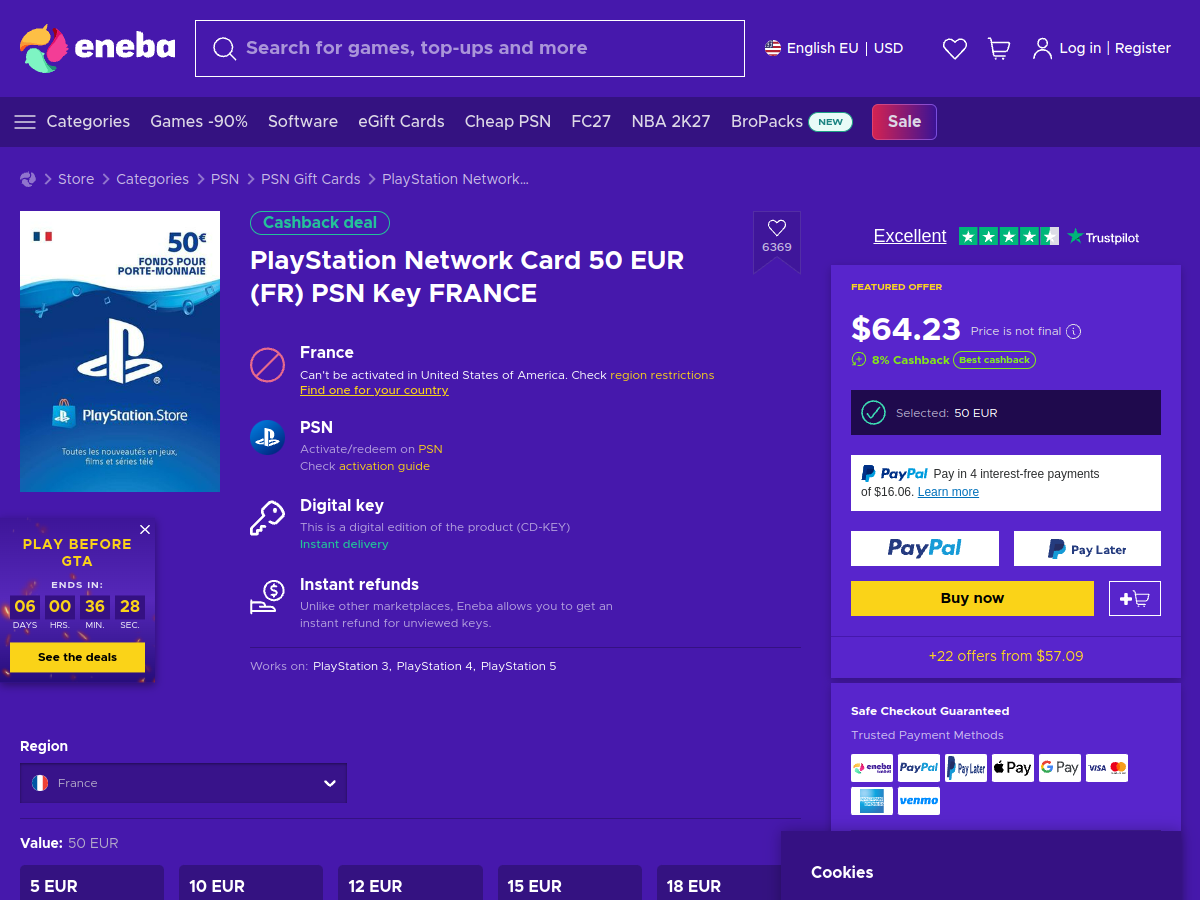
A finding that runs opposite to what we see with CoD Points or V-Bucks (where bigger packs are usually the most discounted): on PSN cards, Instant Gaming keeps a steady discount close to -5% at every tier, while Eneba’s discount shrinks as the card’s value rises, still noticeable at the 10-50 EUR tiers, it becomes almost nonexistent on 80 and 100 EUR cards, where the listed price gets close to, or even slightly above, face value once the cheapest offers are gone. On the bigger amounts, comparing several sellers matters more than ever.
Turkey, Ukraine, Argentina and Brazil
Turkey: the best-documented gap, but local payment is now mandatory
The Turkish PlayStation Store remains, in 2026, one of the cheapest regions in the world according to several specialized price trackers (aidigitalkeys.com, platprices.com): up to -40 to -70% on many games and subscriptions versus US/EU prices. The most documented example is the PlayStation Plus Essential subscription: our dedicated cheap PlayStation Plus guide puts the Turkish rate at roughly $5.96/month in early September 2026 (after a Sony price hike in May 2026), versus $9.70/month in the EU, close to -35%. Nothing guarantees a generic wallet top-up follows the exact same ratio, but the underlying gap remains real.
The catch: Sony has tightened payment rules on Turkish accounts. A foreign card attached to an account billed in Turkey now triggers an explicit decline error (code E2-8211306A) at checkout, according to several specialized guides (marix.app). The only reliably working route is a Turkish PSN gift card, denominated in Turkish lira, bought from a marketplace, or a third-party top-up service that accepts a foreign-currency payment.
Ukraine: the cheapest region on paper, the most closed in practice
Several price indices (platprices.com) rank Ukraine among the cheapest PlayStation Store regions worldwide, at roughly 78% of the converted US median price. But Ukraine is what these same trackers call a “closed region”: you cannot pay with a foreign card there, you need a local payment method or a Ukrainian gift card, rarely available on Western marketplaces. However real the price gap, it stays mostly theoretical for a player with no local contact.
Argentina and Brazil: the false bargain, confirmed
As already documented for CoD Points on this site, Argentina no longer delivers on its “broken region” reputation: according to platprices.com, it now bills between 100 and 105% of the US price, with no real edge for a non-Argentine account, largely due to foreign-currency taxes local banks apply on card payments. Brazil, long cited as a safe cheap bet for the PlayStation Store, also saw digital price hikes in 2026 that drew complaints from players (source: notebookcheck.net): it’s no longer the bargain it used to be.
And what about the account lock?
Just like with CoD Points, the real limit isn’t the price, it’s access: a PSN account’s region is locked for life at creation, with no change option anywhere in the settings (see Method 2 below). A good Turkish or Ukrainian rate is therefore worthless without an entirely new account, registered in that country from the start.
Method 1: key marketplaces (the simple one)
Eneba, Instant Gaming, dlcompare, G2A, or deal-tracking comparators like skibideal.com list PSN cards, generally a few percent below the official price, with no VPN and no account to create: you buy a code and redeem it yourself on your existing PSN account.
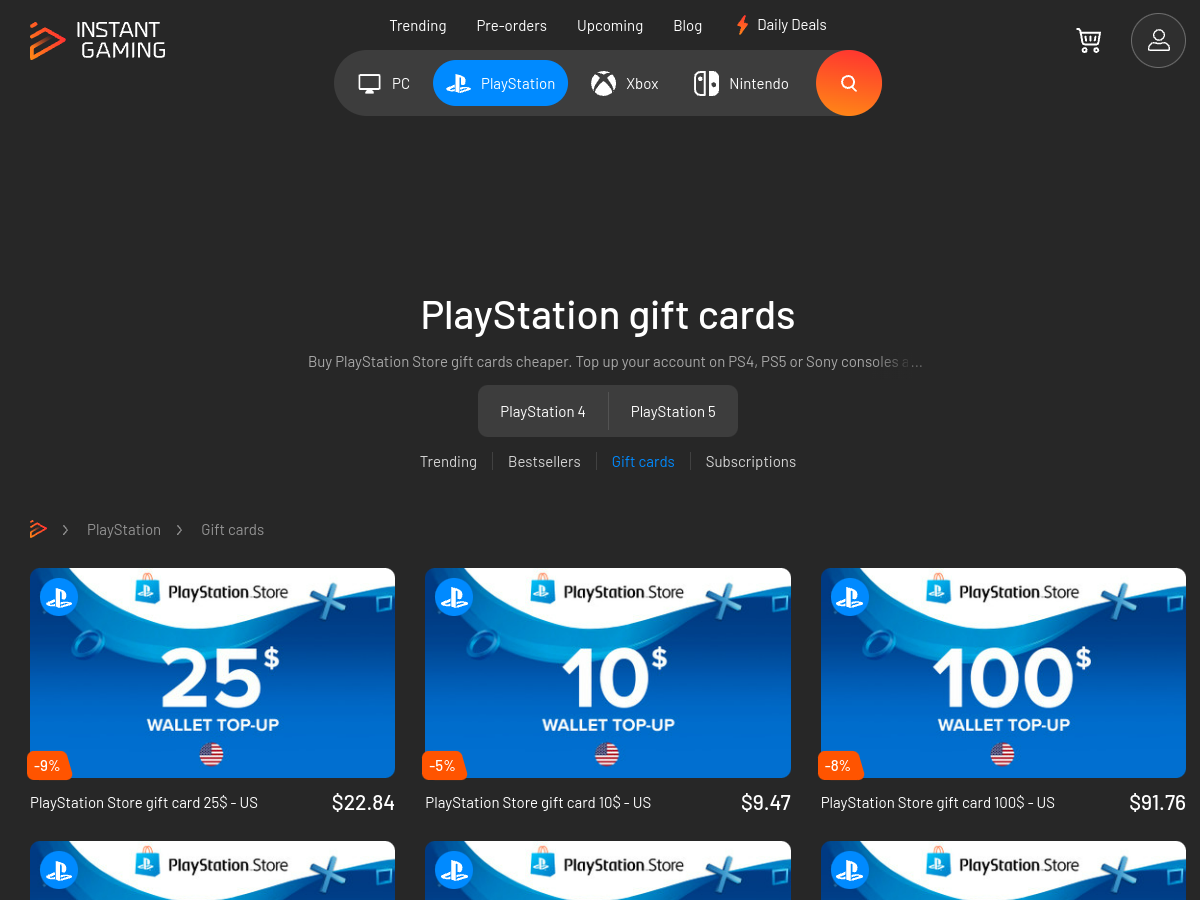
Things to check before buying:
- The card’s region: a “France” card only activates on a PSN account registered in France. There’s no “Global” card for the PlayStation Store, unlike some game keys.
- The type of offer: prefer a code or gift card that you redeem yourself in the PS Store settings. Be wary of “top-up” offers that ask for direct access to your account: the same trap documented for V-Bucks, against the ToS and risky with an unreliable seller.
- The seller: on open marketplaces like Eneba, the “from” price usually points to one specific third-party seller, check their rating and favor buyer protection (card, PayPal) over a direct transfer.
- The bigger tiers (80-100 EUR): as shown above, that’s where the discount shrinks the most on some marketplaces. Compare several sellers rather than trusting the first price you see.
What is PSN credit used for?
Unlike CoD Points, V-Bucks or Apex Coins, a PSN card isn’t tied to one game: it’s a universal credit that funds your PlayStation Network account’s wallet. Once redeemed, that credit can go toward:
- Buying full games and DLC on the PlayStation Store, without using a bank card.
- Paying for a PlayStation Plus subscription (Essential, Extra or Premium), instead of or alongside an automatic card renewal.
- Topping up in-game currencies sold on the Store, like Fortnite’s V-Bucks or CoD Points, when they’re offered as a paid pack rather than a direct real-currency purchase.
- Paying for some third-party subscriptions accessible from the Store (Spotify, for instance, has historically been billable this way). That use is less certain in 2026, though: Sony has gradually moved several subscriptions to billing the registered payment method directly rather than the wallet balance, so check at checkout that PSN credit is actually offered as a payment option.
That versatility, combined with no expiration date, is why the PSN card remains one of the most-searched gift card products, well beyond players of any single title.
Method 2: VPN + regional PSN account (the most restrictive)
The classic move: connect from a country where the PlayStation Store is structurally cheaper (Turkey, Ukraine, see above) to get the local rate. On PlayStation, this mechanic is considerably heavier than on Battle.net or even Xbox.
It’s the account that’s locked, not the card
Sony locks a PSN account’s region at creation, and there is no official way to change it afterward on an existing account. To get a foreign price, you have to create an entirely new PSN account (a new email address), registered in the target country, with a VPN active for the whole signup. The consequence: you start from zero. No game library, no friends list, no trophies from your main account carry over to this second one. For a simple wallet top-up, it’s rarely worth the hassle, unless it’s a well-planned one-off (a dedicated secondary account for the purchase, for instance).
The real friction point: the payment method
A standard Western card is usually rejected on an account billed in Turkey or Ukraine, or triggers a conversion that wipes out the saving. Per specialized guides on the topic, a Turkish account even shows an explicit payment error (E2-8211306A) against a foreign card. Two concrete workarounds: a regional PSN gift card (denominated in Turkish lira or Ukrainian hryvnia) bought from a marketplace, or a multi-currency virtual card (Revolut, Wise), which improves the odds without a full guarantee.
A friction the marketplace method avoids entirely
It’s precisely because Method 1 (marketplaces) requires neither a new account nor a foreign card that it stays the simplest option for most players: the VPN + regional account method mainly makes sense for a repeated, substantial saving (an annual PS Plus subscription, say), not for a one-off 50 EUR top-up.
Best VPNs for the regional-account method
- Reliable Turkey servers for signup
- 9,200+ servers, fast NordLynx
- Threat Protection (gift-card phishing)
- Unlimited connections
- Turkey/Ukraine servers
- Low price for a one-off use
- Swiss, open source, audited
- Plus plan: 140+ countries
- 30-day refund
What NOT to do
- Use a “free PSN credit” generator: none are legitimate, they all lead to phishing (stealing your Sony login), a fake survey, or malware. No real credit is ever delivered.
- Buy a bargain-priced code on a forum or messaging app outside a known marketplace: real risk of a code already obtained through card fraud (carding), disabled by Sony after a few days.
- Share your PSN login with a third-party “top-up” service that claims it will credit your account itself: against the ToS, real risk of account theft.
- Buy a region-locked card without checking compatibility: a flat loss if the card can’t be redeemed on a France account.
- Use a Western card to fake foreign billing: detection, rejection (see the E2-8211306A error on Turkish accounts), sometimes an account block.
- Use a free VPN for the regional-account method: IPs blacklisted by Sony, failed payments, and a real risk of malware from the VPN itself.
Verdict: how to get a cheap PSN card
- →One-off purchase, any amount? Instant Gaming: a steady discount around -5% at every tier, a code you redeem yourself, no VPN and no account to recreate.
- →Going for an 80 or 100 EUR card? Compare several sellers before buying: on Eneba, the discount shrinks to almost nothing on these bigger tiers.
- →Ready to start over for a repeated saving? A new Turkey or Ukraine PSN account via VPN plus a local gift card: a real gap, but you start from zero (library, friends, trophies).
- →Tempted by "free PSN credit"? It doesn't exist: every generator is a scam, no credit is ever actually delivered.
See also: VPN savings hub, Cheap PlayStation Plus, VPN for PS5.