Analysis based on CometVPN’s official pages and public sources, all checked on 12 November 2026. This page contains partner links.
CometVPN at a glance
CometVPN is a VPN operated by COMET TECH INC., a company registered in Panama. Its core pitch fits in one sentence: on top of a classic VPN, it sells residential IP addresses, meaning addresses that internet providers assign to homes, to slip past sites that block VPNs. All of it from $1.89 per month on the 24-month plan, with a 3-day trial (bank card required).
Our quick verdict: CometVPN is an interesting and very cheap option if you specifically want a residential IP or a backup VPN to get around blocks. Its limits are clear: no independent audit published, session metadata kept for up to 9 months, a 30-day guarantee that excludes the 1-month plan and cryptocurrency payments, a small standard network and very few independent reviews. It is not a rival to NordVPN or Proton VPN on trust, but a niche alternative worth knowing about.
See CometVPN’s plans on the official site →
Who is behind CometVPN?
The official site presents the company COMET TECH INC., established in Panama City (Advanced Tower Building, Ricardo Arias street), registration number 155734567. The privacy policy gives the same address for complaints. Panama is not part of the “14 Eyes” intelligence alliance, and the provider makes that a selling point. A jurisdiction argument is not, however, proof that logs are not kept, as we detail below.
A few points of context worth flagging:
- the Terms of Service are governed by Cypriot law, with arbitration in Cyprus, which does not match the Panamanian address;
- the App Store listing for the iPhone and Mac app names Simoresta UAB as the publisher, a different name from the company cited on the website;
- directories and media disagree on the launch date of the service (from 2022 to 2024 depending on the source); the provider’s partner program says 2023.
These discrepancies do not in themselves point to a problem, but they show that before entrusting your traffic to a young service, it is worth reading its legal documents. That is what we did.
Pricing: very low, but in dollars and before VAT
The prices below are those of the cometvpn.com/pricing page read on 12 November 2026. They are shown in US dollars, VAT extra.
| Plan | Displayed price | Monthly equivalent | Note |
|---|---|---|---|
| 1 month | $9.99 | $9.99 | Not refundable |
| 12 months | $30.00 | $2.50 | “+1 month free”, 30-day guarantee |
| 24 months | $45.36 | $1.89 | “+3 months free”, 30-day guarantee |
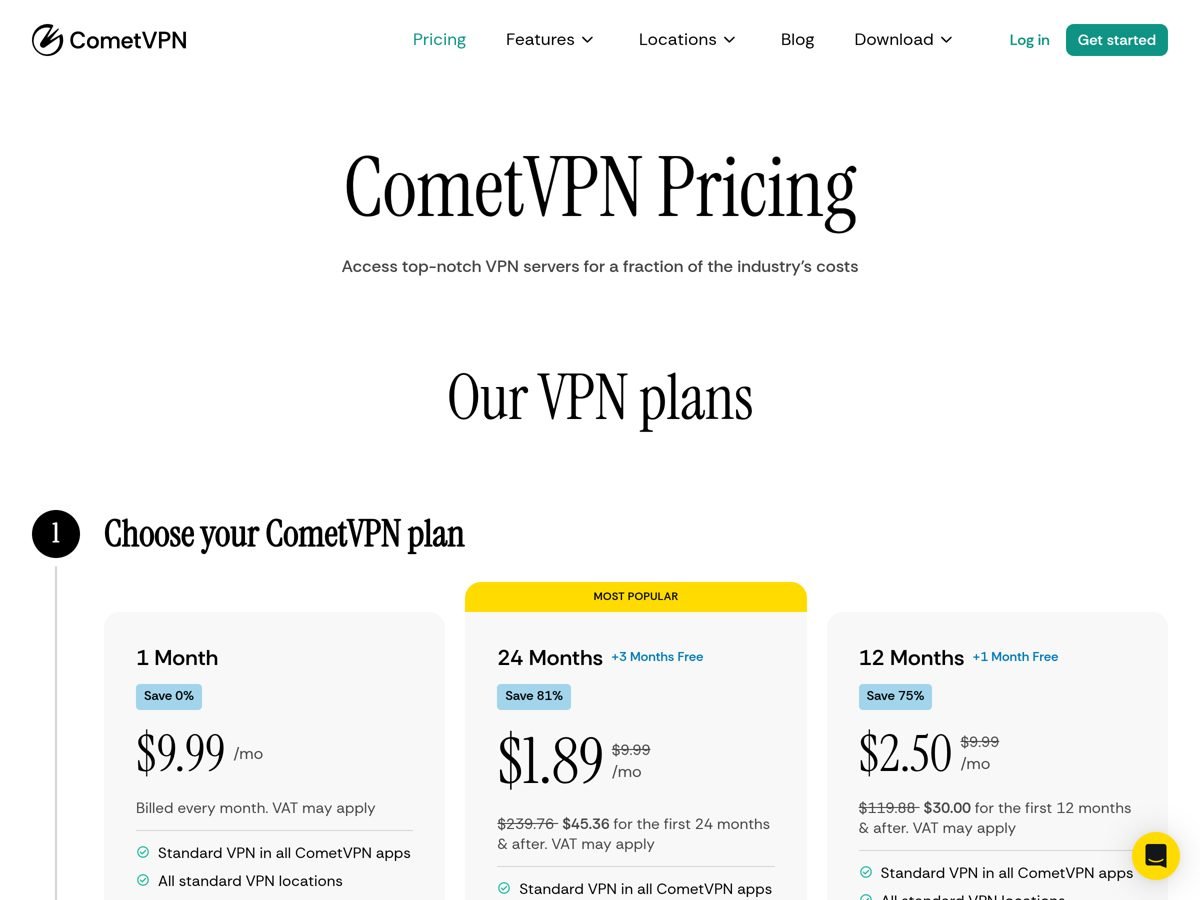
Three useful points:
- The displayed price is “$45.36 for the first 24 months and after”. We found no separate renewal rate on the pricing page. The Terms of Service add that when a subscription is bought with a code or discount, renewals stay at the same price as long as the subscription is not cancelled; if you cancel, a new order is billed at the price in force. Worth watching if you plan to stay for several years.
- The price in euros depends on the exchange rate and on VAT: for a French buyer, the final amount will differ slightly from the direct conversion.
- Residential options are not included: they are added to an active subscription, see below.
Discounts and final price
As of 12 November 2026, the public pricing page shows no discount beyond the prices above (the “Save 81%” and “Save 75%” labels compare each plan with the one-month price). The amount actually charged, VAT included, only appears at checkout: check it before you confirm, and be wary of promo codes found on third-party sites.
The residential offer: what CometVPN does differently
This is CometVPN’s real reason to exist. Classic VPNs use servers hosted in data centers: their address ranges are public, and the services that detect VPNs (streaming platforms, banks, social networks) block them wholesale. A residential address is assigned by an internet provider to a home subscriber; it looks like that of an ordinary visitor.
CometVPN sells two distinct products on top of the standard VPN:
| Native residential VPN | Dedicated residential IP | |
|---|---|---|
| Displayed price | from $0.70 per GB | from $2.79 per month |
| Address | rotating or “sticky” (up to 24 h) | fixed, reserved for you |
| Targeting | country, state, city, internet provider | country (and state in the US) |
| Use | apps or proxy credentials | WireGuard configuration files |
| Who it is for | geographic testing, hard-to-reach access | account access, allowlisting |
The site advertises more than 32 million addresses in more than 195 countries and territories for the native product, and purchased traffic that never expires. The partner portal also mentions a “Residential VPN” option from $1.74 per month, which does not appear on the public pricing page of 12 November 2026: we do not count it.
What this really implies
The official text on the native residential VPN page explains that these addresses come from devices in ordinary homes, after their consent has been obtained, which serve only to relay traffic (with no access to the device). In other words, you are using a residential proxy network: CometVPN does not own these lines. That has three consequences to keep in mind:
- speed: the Spider’s Web test (see below) stresses that traffic goes through partner networks and that throughput is several times lower than on classic servers; it is a backup mode, not a permanent one;
- cost: billing is per GB, so the bill rises quickly with streaming or downloads;
- the consent question: in the industry, the origin of the connections and the consent of the households are a recognised point of vigilance. Apart from that one FAQ sentence, we found no detailed page on how households are recruited and how their agreement is collected. It is up to you to weigh this point according to your values.
A review published on Trustpilot in August 2026 describes a case where an address presented as located in Fort Myers (Florida) showed up as Chicago in external checks; the provider replied that city-level coverage applies to the native residential VPN and that its standard servers are at state level. It is an example worth knowing: the geographic accuracy of a residential IP is never guaranteed down to the city.
Logs and privacy: a detailed policy, with no audit
The privacy policy (update date shown as “08/12/2026” on the page, an ambiguous date format) is long and readable. Here is what the provider writes, in summary:
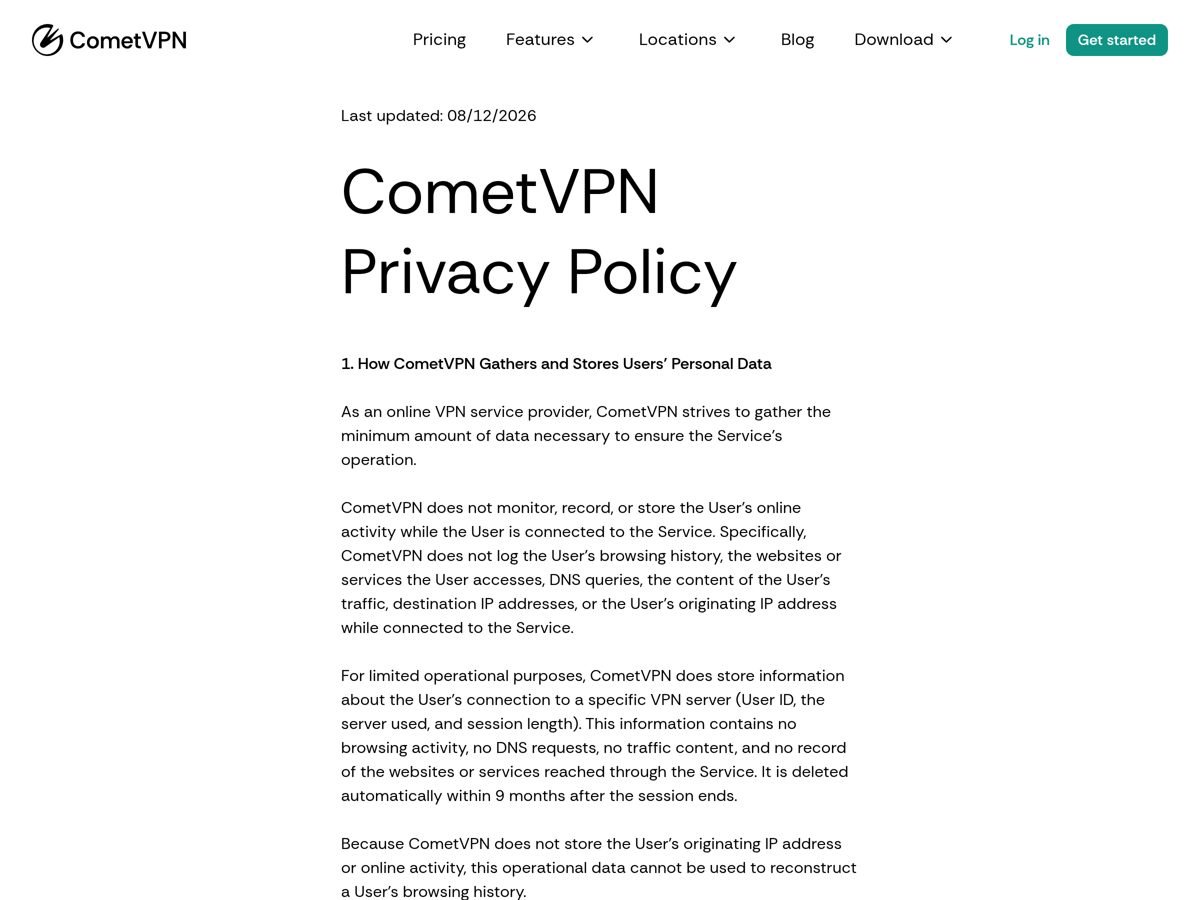
- No activity log: no browsing history, no DNS queries, no destination IP addresses, no traffic content, and no source IP address during the connection.
- But session metadata: the user ID, the server used and the session duration are recorded for operational reasons, then deleted automatically within 9 months.
- Account and payment data: email address, hashed password, the cardholder’s last name and the last four digits of the card (fraud prevention), transaction references.
- Third-party providers: Sentry (error reports tied to the account ID and email), Intercom (support), Google Analytics and Microsoft Clarity (website statistics, optional for visitors from the EU and the UK), several payment processors.
- No sale of data: the provider says it does not sell or trade personal information.
Two reading notes. First, the Terms of Service speak of a “strict no activity logging” policy without mentioning this session metadata, and the App Store listing says the app does not store session timestamps, whereas the privacy policy keeps a session duration: the wording does not overlap exactly. Second, and above all, we found no independent audit of these commitments (nor a transparency report) on the provider’s website as of 12 November 2026. By way of comparison, NordVPN and Proton VPN publish third-party audits. Without an audit, CometVPN’s policy rests on trust, like that of PrivateVPN on this specific point.
In practice: for streaming, public Wi-Fi or getting around blocks, this level of transparency is acceptable. For a use where a metadata leak would have serious consequences (sensitive journalism, activism under a repressive regime), prefer an audited or open-source service.
Performance and features
The speed figures quoted here belong to their author. The only detailed public measurement we found is that of Spider’s Web (Poland, 25 September 2026), an article flagged as product placement, so to be read with distance. The outlet reports, on a 918 Mb/s fiber line, 888 Mb/s with WireGuard on a German server (about 3% loss), 760 Mb/s to the United States, and only under 45 Mb/s with OpenVPN on the same server: the practical conclusion is to stay on WireGuard. The same article notes no DNS or WebRTC leak and a working kill switch during its checks.
What the provider announces on features:
- WireGuard and OpenVPN protocols, AES-256 encryption, kill switch, DNS leak protection;
- obfuscated servers included at no extra cost;
- apps for Windows, macOS, iOS, Android, Apple TV and Chrome and Firefox extensions; Firestick, router and smart TV require manual setup;
- payment by card, PayPal and cryptocurrencies (but with no refund guarantee in that case).
What is missing, according to the same sources: no multi-hop, no ad and tracker blocker, no Linux app, and split tunneling available only on Android at the time of the Polish article. The number of countries in the standard network varies by page: 50+ locations on the trial page, “70+ countries” on the App Store listing, 54 countries counted by Spider’s Web. For simultaneous devices, the home page says “up to 10” while the pricing page speaks of “unlimited” use: assume 10 to be safe.
Streaming: where the residential IP changes the game
Streaming services block data center address ranges first. This is the use case where residential brings something. In its test, Spider’s Web reports that BBC iPlayer (known to be difficult) rejected a standard London server but accepted a UK residential IP, that Netflix showed the regional catalogue on standard US and UK servers already, without needing residential, and that TVP VOD let a Polish residential server through where the foreign address triggered a warning.
Take these results as indications dated September 2026, not as a promise: platforms regularly tighten their detection. For everyday streaming, a classic VPN known for unblocking, for example NordVPN or ExpressVPN, remains a simpler and faster choice; CometVPN’s residential option is a fallback when standard servers fail.
Free trial and guarantee: the rules to know
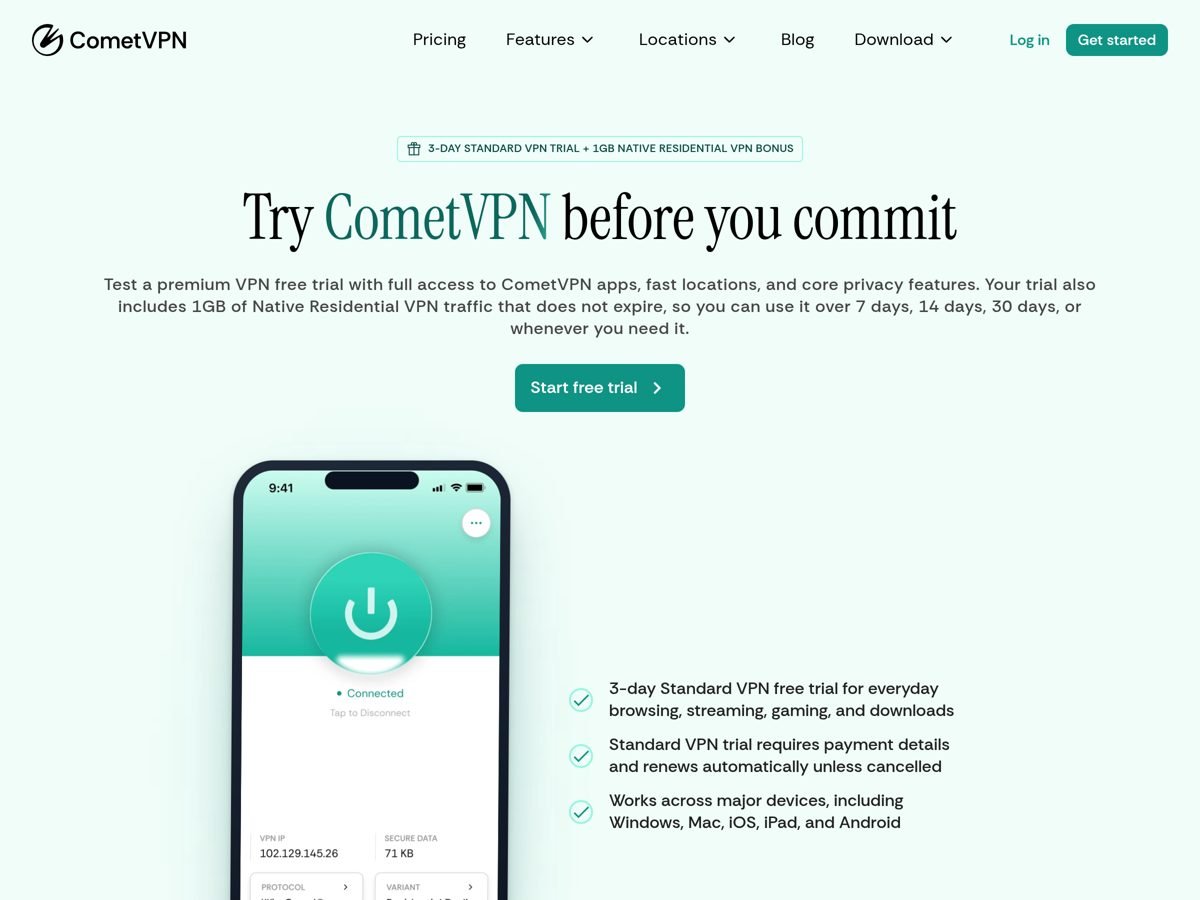
The trial (page cometvpn.com/vpn-free-trial) gives 3 days of standard VPN and 1 GB of native residential VPN. Conditions: bank card required and automatic renewal if you do not cancel before the end. In its reply to a Trustpilot review of 27 August 2026, the provider states that cancelling during the trial ends access immediately, to prevent abuse; it adds that it is considering making this clearer before confirmation. Our advice: put the end date in your calendar and cancel on the last day rather than the first.
The 30-day guarantee is narrower than it looks:
- it applies to the 12 and 24-month plans, once per account, from the first order;
- the 1-month plan is not refundable;
- it does not apply to cryptocurrency payments;
- for a purchase through the App Store or Google Play, the store handles the refund;
- native residential traffic already used is not refundable;
- the request goes by email to support, with a delay of 5 to 10 business days depending on the payment method.
The provider’s partner portal says “all plans” benefit from the guarantee: it is the Terms of Service page that prevails, and it excludes the 1-month plan.
What users say
Independent sources are few, which is normal for a recent service. As of 12 November 2026:
- Trustpilot: 4 out of 5, on 34 reviews. Positive reviews praise the price, support responsiveness and the quality of the residential IPs; negative reviews concern the accuracy of locations, the trial conditions, the gap between a country that is promoted and the servers actually available, and, according to some, refund difficulties that we could not verify. The provider replies to reviews, including negative ones. A sample of this size should be read with caution: a few reviews are enough to move the score.
- App Store: 3.6 out of 5 on 8 ratings (iPhone and Mac app listing).
- Product Hunt: a rating of 5 from only a few reviews; G2 shows no reviews.
We did not use the testimonials displayed on the provider’s website (generic names, no source or date): they are not independent reviews.
CometVPN vs NordVPN and Proton VPN
| Criterion | CometVPN | NordVPN | Proton VPN |
|---|---|---|---|
| Entry price (long plan) | $1.89/month, VAT extra | €3.49/month | €3.49/month |
| Independent no-log audit | None published | Yes | Yes |
| Residential IP | Yes (paid options) | No | No |
| Standard network | 50+ locations | 129 countries | 140 countries |
| Guarantee | 30 days (12 and 24 months only) | 30 days | 30 days |
| Multi-hop | No | Yes | Yes (Secure Core) |
| AvisVPN rating | 7.4/10 | 9.6/10 | 9.0/10 |
The NordVPN and Proton VPN prices are those of our own reviews outside temporary promotions (long plans, in euros); comparing dollars before VAT with euros including VAT remains approximate. On trust, network and features, the two references keep a lead. On the residential offer alone, CometVPN is the only one in our selection to sell it.
Who is CometVPN for?
Yes if you are looking for:
- a residential or dedicated IP (account management, regional content testing, hard-to-reach access);
- a very cheap VPN to complement a main VPN;
- a VPN that is simple to install, with WireGuard and obfuscated servers included.
Consider an alternative if you want:
- an audited service: NordVPN, Proton VPN or ExpressVPN;
- a very large network and advanced features (multi-hop, ad blocker, Linux);
- a broad refund guarantee, including on cryptocurrency payments and on the monthly plan.
How we rated CometVPN
Our score of 7.4 out of 10 is a documentary assessment: it rests on the provider’s official pages, its terms and its privacy policy, and on the public sources cited above, all dated 12 November 2026. Price (9.0) weighs in the service’s favor; security (6.5) is held back by the absence of an audit and the 9-month retention of session metadata; speed (8.0) and streaming (8.0) rest on a single public measurement, flagged as product placement; ease of use (8.0) comes from simple apps and the included obfuscated servers. The score will be revised when an independent audit is published or if our own checks change the picture.
Our final verdict
CometVPN is a niche, very affordable VPN whose interest lies in its residential offer, rare among mainstream VPNs. Its limits are real: no independent audit, session metadata kept for up to 9 months, a guarantee that does not cover every plan, a modest standard network and a native residential option that is slower and billed per GB. For a main VPN, we still recommend NordVPN; to complement that VPN with a residential IP when classic servers fail, CometVPN is a credible option, to be tried with the end of the trial in mind.
✅ Strengths
- The only VPN in our selection selling native residential and dedicated residential IPs
- Very low entry price on the 24-month plan (1.89 USD/month)
- 3-day trial, WireGuard and obfuscated servers included
- A detailed, readable privacy policy
❌ Weaknesses
- No independent audit published
- Session metadata kept for up to 9 months
- 30-day guarantee limited to 12 and 24-month plans, crypto excluded
- Small standard network (50+ locations), no multi-hop, no Linux app