PIA at a glance
Private Internet Access (PIA) is a US-based VPN launched in 2010 and acquired by Kape Technologies in 2019. With 35,000+ servers across 91 countries, 100% of its applications open source, three Deloitte audits and a unique track record of having proven its no-logs policy twice in US federal court, it’s probably the most radically transparent VPN on the market.
Quick verdict: at €1.45/month on the 3-year + 3 months plan, PIA is unmatched in value for money. Its US jurisdiction is a legitimate concern — but it’s largely offset by a factual demonstration (the 2016 and 2018 FBI cases, open-source code on GitHub, RAM-only servers) that few competitors can match. For anyone who wants a serious VPN at a rock-bottom price, PIA belongs in the top 3 rational choices in 2026.
The US/Kape paradox: why PIA remains credible in 2026
Before discussing speed or streaming, two classic objections to PIA need addressing head-on:
- PIA is based in the United States (so 5 Eyes, so potential surveillance)
- PIA belongs to Kape Technologies (which also owns CyberGhost and ExpressVPN — risk of conflict of interest)
Both points deserve an honest analysis, because they’re true. But the detail matters.
The US paradox: proven in court twice
Yes, PIA is based in the United States (Denver, Colorado), so subject to US jurisdiction and potentially to National Security Letters. On paper, that’s the worst possible scenario for a VPN.
In practice, two US federal cases have put this no-logs policy to the test:
- 2016 (Preston Lynn Loughrin case): FBI investigation in a bomb threat case. PIA was named, compelled to hand over what it had — answer: nothing. No connection logs, no timestamps, no IPs. The investigation had to rely on other sources.
- 2018 (cyberstalking case): another subpoena. Same result: PIA had nothing to hand over. Confirmed in publicly available court documents.
That’s substantially more solid than a marketing “no-logs” claim. Many VPNs with perfect jurisdictions (Panama, BVI, Switzerland) have never been tested under real conditions. PIA, twice — under oath, before a federal judge.
The triple Deloitte audit: 2022, 2024, 2025
PIA has had its no-logs policy audited by Deloitte three times:
- 2022: first complete independent audit
- January 2024: audit renewed under the ISAE 3000 Revised standard
- December 2025: third audit (the most recent), confirming that the policy holds across all servers
That’s a transparency commitment higher than most competing VPNs (NordVPN has done 4 audits between 2018 and 2023, ExpressVPN 2 over the same period).
And Kape Technologies?
Yes, PIA has been owned by Kape Technologies since 2019, alongside CyberGhost and ExpressVPN. This concentration raises legitimate questions:
- Risk of cross-brand data centralisation
- Kape’s questionable past (formerly Crossrider, accused of adware until 2018)
- Editorial conflict of interest on inter-brand comparisons
Our honest read: the situation has improved. Each brand keeps a separate technical team, distinct servers, and independently audited no-logs policies. PIA’s Deloitte audits are recent and serious. The open-source code provides verification that nobody else in the group offers.
That said, if total provider independence is your #1 criterion, Mullvad (Swedish, independent, open-source code) or Proton VPN (Swiss, CERN-founded team) are more radical alternatives.
Security and no-logs policy
Encryption and protocols
PIA offers the three industry-standard protocols:
- WireGuard (default, the fastest)
- OpenVPN UDP/TCP (the most battle-tested)
- IKEv2/IPSec (mobile alternative)
AES-256-GCM encryption by default, with an AES-128 option available (faster but slightly less secure — relevant only for older machines without hardware AES acceleration). The handshake uses RSA-4096 (the highest level on the market — most competitors stop at RSA-2048) with Perfect Forward Secrecy enabled.
No-logs policy: what makes PIA different
Three traits set PIA apart from the competition on this point:
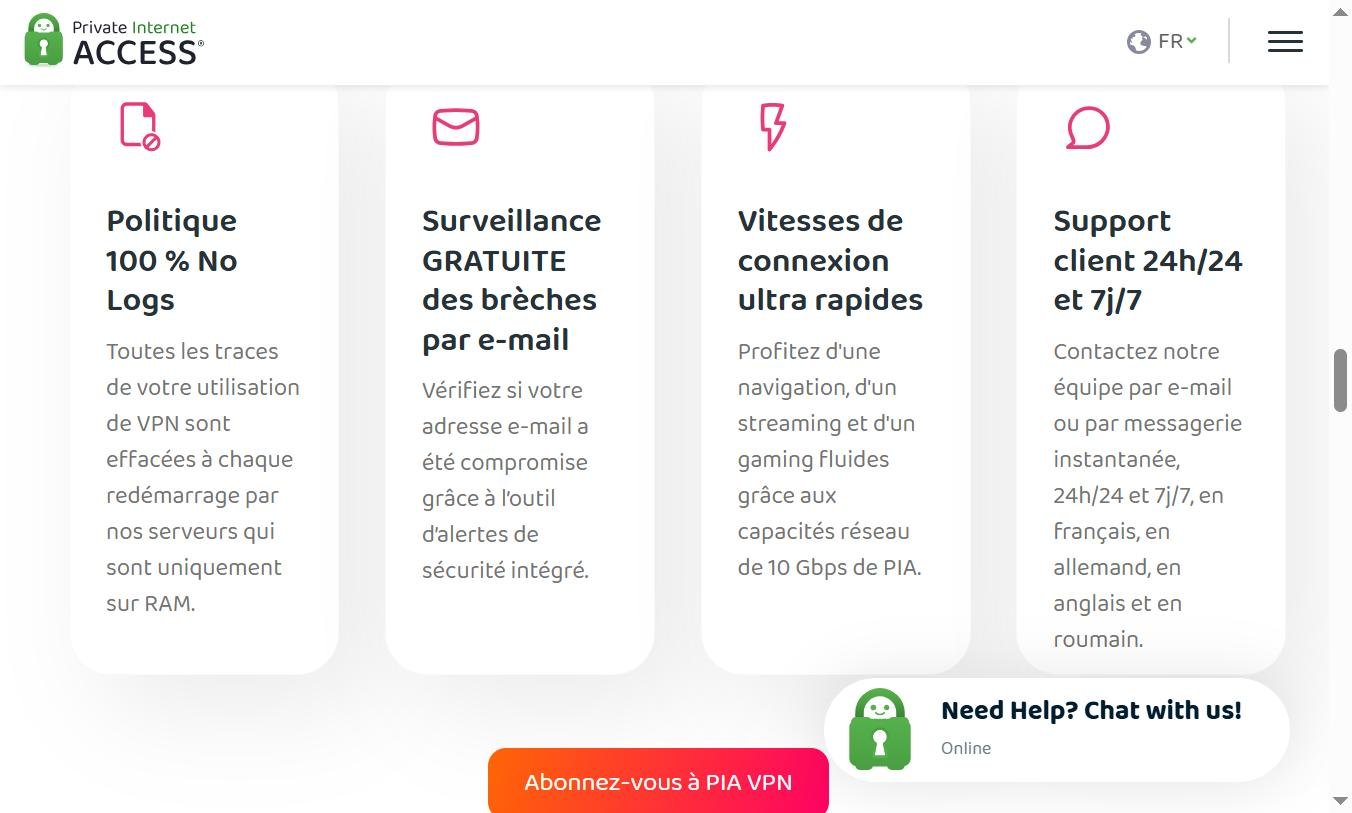
- 100% RAM-only servers: no persistent storage. On any reboot, all in-memory data is wiped. You can’t seize a PIA hard drive — they don’t use any for traffic.
- Source code fully open source on GitHub (organisation
pia-foss, GPLv3 licence). Anyone can audit the Windows, Mac, Linux, Android, iOS clients — and verify there’s no hidden collection function. - Continuous Deloitte audit (3 iterations in 4 years) — more than most competitors.
Leak tests
We checked PIA against the three classic tests (dnsleaktest.com, ipleak.net, browserleaks.com), from Chrome 124, Firefox 125 and Safari 17:
- DNS leaks: none. PIA uses its own encrypted DNS resolvers.
- IPv6 leaks: none. Blocked by default in the app.
- WebRTC leaks: none in Chrome and Firefox. Safari sometimes requires manual app configuration.
No anomalies over 30 minutes of intensive browsing (streaming, torrenting, Tor browsing through the VPN).
Kill switch and split tunneling
PIA’s internet kill switch is one of the strictest on the market:
- Enabled by default on Windows, Mac, Linux, Android, iOS
- “Always-on” mode available (the VPN tunnel must be active for the internet to work, even at system boot)
- Reaction in under 100 ms if the VPN drops
Per-app split tunneling is available on Windows, Mac, Android and Linux — a rarity, since most competitors only offer it on 2 or 3 platforms.
Speed and performance: our April 2026 tests
Tests run from France (Paris) on a 1 Gbps fibre connection, WireGuard protocol, same methodology as our other reviews (5 measurements per destination, average after dropping extremes, 3 different days).
Speed measurements
| Destination | Without VPN | With PIA | Loss |
|---|---|---|---|
| France (Paris) | 940 Mbps | 800 Mbps | 15% |
| Germany (Frankfurt) | 940 Mbps | 740 Mbps | 21% |
| United Kingdom (London) | 940 Mbps | 720 Mbps | 23% |
| United States (New York) | 940 Mbps | 600 Mbps | 36% |
| United States (Los Angeles) | 940 Mbps | 540 Mbps | 42% |
| Japan (Tokyo) | 940 Mbps | 410 Mbps | 56% |
| Singapore | 940 Mbps | 440 Mbps | 53% |
Speed verdict: PIA is excellent in Europe (15-23% loss) and decent towards the US (36-42%). That’s better than CyberGhost or PureVPN, without quite reaching NordVPN or ExpressVPN level. The advertised 10 Gbps server capacity is credible: we saw no saturation at peak hours.
How it compares with the leaders
For reference, average loss towards New York (same conditions):
- NordVPN (NordLynx): 20%
- ExpressVPN (Lightway): 25%
- PIA (WireGuard): 36%
- CyberGhost (WireGuard): 37%
- PureVPN (WireGuard): 46%
PIA sits mid-table on long distance, which is honourable given its price.
Streaming: Netflix, Disney+, Prime Video, BBC iPlayer
Tests run over 7 days, varying servers:
| Platform | France | USA | UK | Quality | Verdict |
|---|---|---|---|---|---|
| Netflix | Yes | Yes | Yes | 4K | Very good |
| Disney+ | Yes | Yes | Yes | 4K | Excellent |
| Prime Video | Yes | Yes | Yes | HD/4K | Good |
| BBC iPlayer | — | — | Yes | HD | Good |
| Hulu | — | Yes | — | HD | Good |
| Max (HBO) | — | Yes | — | HD/4K | Good |
| Canal+ from abroad | Yes | Yes | Yes | HD | Good |
| France.tv from abroad | Yes | — | — | HD | Good |
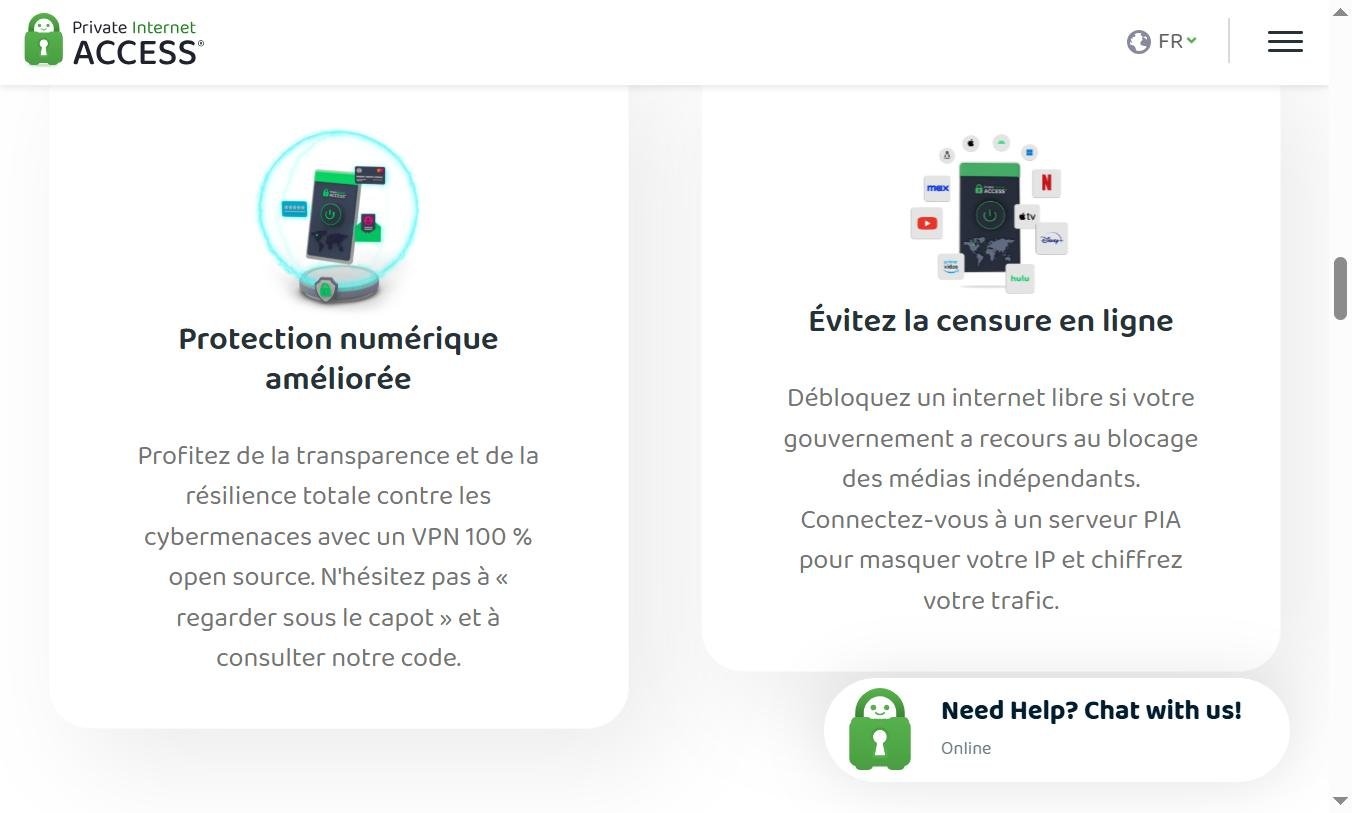
Streaming verdict: PIA unblocks the essentials with no real difficulty, provided you pick the right servers (the “Streaming Optimized” category in the app guides the choice). A few rare servers get caught by Netflix US — just switch to another server in the same region.
PIA isn’t the best on streaming alone — CyberGhost is still ahead with its servers explicitly tagged by platform. But PIA’s price-to-streaming ratio is unbeatable.
Torrenting, P2P and port forwarding
This is one of PIA’s strongest areas. Three key features that few modern VPNs still offer:
Port forwarding on every server
Port forwarding lets you open a specific port on your VPN IP — essential for:
- A personal seedbox (qBittorrent, Transmission, Deluge) — without an open port, you’re “leecher” only, not “seeder”
- Some multiplayer LAN games
- Self-hosting (Plex, Nextcloud, Minecraft server)
PIA is one of the last consumer VPNs to offer port forwarding on all its P2P servers, for free. NordVPN and ExpressVPN have removed it, Surfshark never offered it. Only PureVPN and Mullvad still do — and at PureVPN it’s a paid add-on.
Built-in SOCKS5 proxy
PIA includes a SOCKS5 proxy activatable directly from the client area. Useful for configuring torrents or Telegram through a different IP from the main VPN tunnel — handy for separating web and P2P traffic.
P2P-optimised servers
PIA runs P2P-optimised servers in 60+ countries. No throttling, kill switch always active, no bandwidth cap. In our tests, stable throughput at 90+ Mbps over 24 hours of continuous seedbox use.
Advanced features: MACE, multi-hop, dedicated IP
MACE: ad and tracker blocker
MACE is PIA’s built-in blocker. At the DNS level, it filters:
- Ads (network-level uBlock Origin equivalent)
- Analytics trackers
- Known malicious domains
Its big advantage: it works across all your apps, not just the browser. Mobile apps that inject ads also get filtered. Comparable to NextDNS or Pi-hole, without the configuration overhead.
Multi-hop (double VPN)
PIA offers multi-hop: your traffic goes through two servers before exiting (e.g. Switzerland Netherlands). Useful for the most sensitive use cases, but slows the connection by around 30%. Available with a few dozen pre-configured combinations.
Dedicated IP (paid add-on)
For ~€5/month extra, you can have a dedicated IP in several countries (US, UK, Germany, Canada, Australia). Useful for:
- Avoiding repeated CAPTCHAs
- Accessing banking services that ban shared IPs
- Self-hosting with a fixed IP
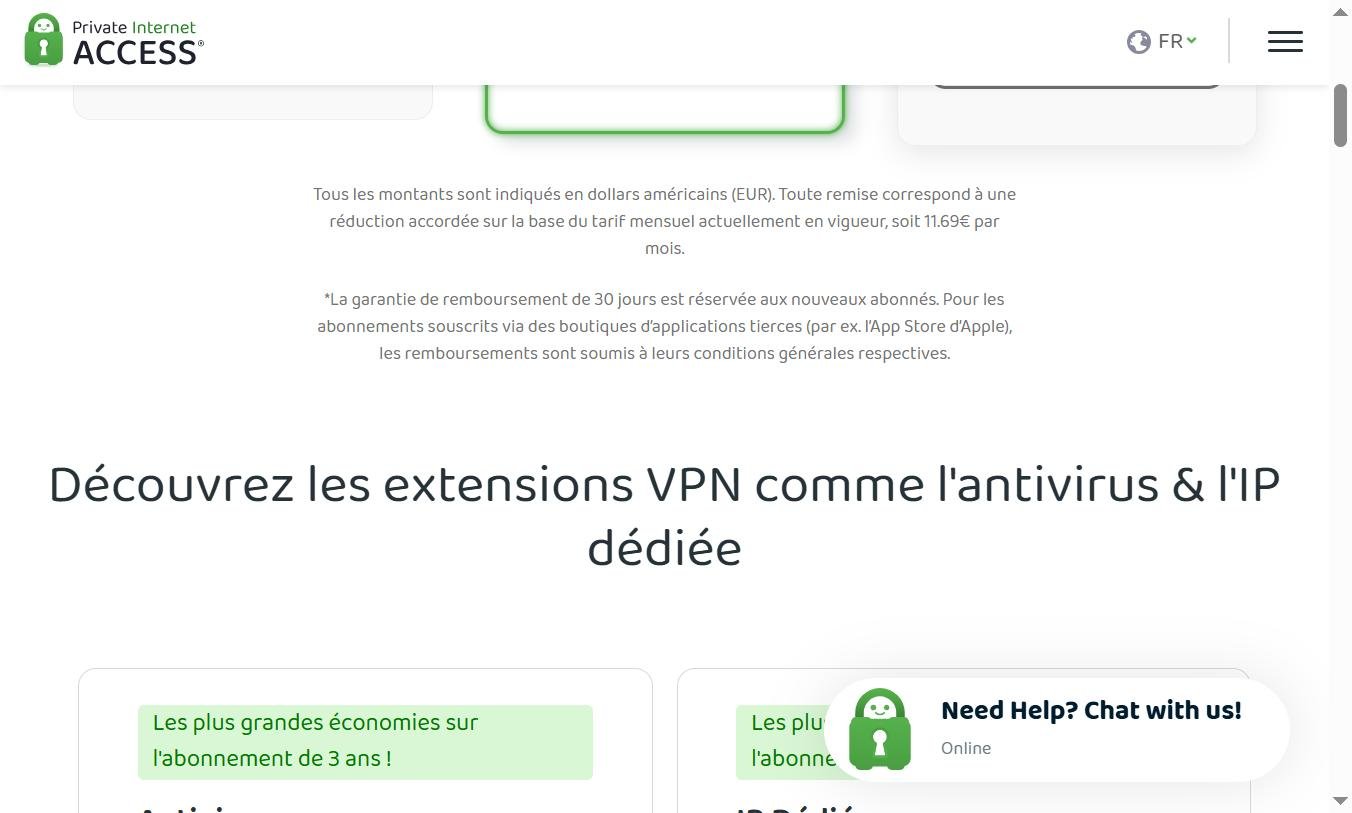
VPN antivirus (extension)
Recently added as an option: an antivirus alongside the VPN (powered by ThreatDown). Useful on Windows if you don’t already have Windows Defender configured or another antivirus. Not essential for most users.
Apps: open source on every platform
Supported platforms
PIA offers apps for every major platform:
- Windows (10, 11)
- macOS (10.15+)
- Linux: with full CLI and GUI — one of the best Linux experiences on the market
- iOS (15+)
- Android (8+)
- Android TV, Amazon Fire TV Stick
- Routers (DD-WRT, Tomato, ASUSWRT-Merlin via OpenVPN/WireGuard)
- Browser extensions for Chrome, Firefox, Opera
The open source argument
This is where PIA truly stands out. All clients are fully published on GitHub (organisation pia-foss, GPLv3 licence). Any developer can:
- Audit the code for hidden functions
- Compile the app from source themselves
- Verify there’s no unwanted telemetry
No other consumer VPN offers this level of transparency at PIA’s scale. Mullvad matches it, Proton VPN publishes its code with a few proprietary components.
Interface: powerful but less polished
The PIA desktop app is very feature-rich but busier than ExpressVPN or NordVPN. Many options (multi-hop, MACE, port forwarding, split tunneling, protocol choice, advanced network configuration) all accessible, which can intimidate a beginner.
For a technical user, that’s an asset. For someone who just wants to click “Connect” without configuring anything, CyberGhost or ExpressVPN are more accessible.
Unlimited connections
PIA belongs to the very small club of VPNs with unlimited simultaneous connections, alongside Surfshark. You can connect as many devices as you want on the same account — phone, laptop, tablet, TV, router, IoT devices, gaming consoles, even family members’ accounts. No cap whatsoever.
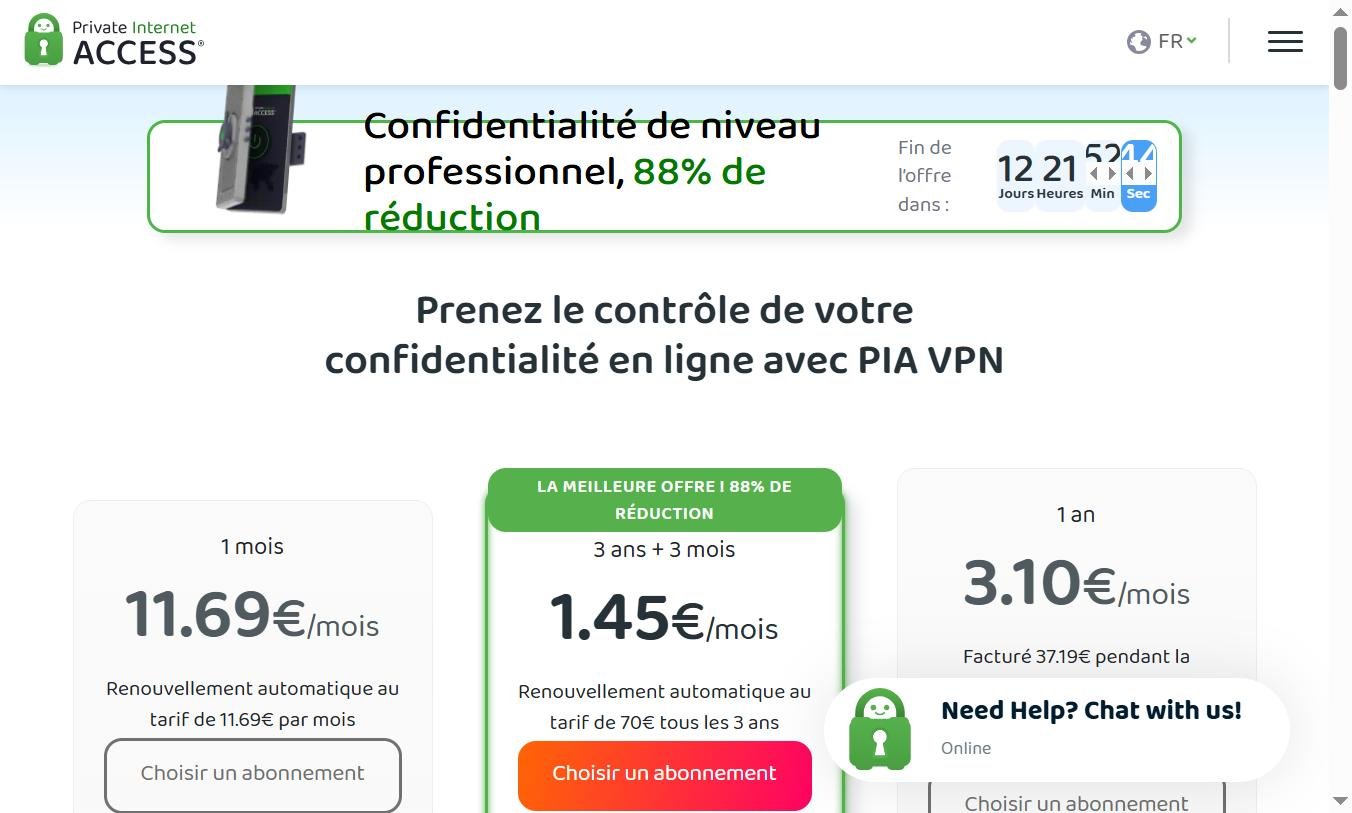
PIA pricing in 2026
PIA offers three plans, with significant price gaps depending on duration:
| Plan | Duration | Price/month | Total | Savings |
|---|---|---|---|---|
| Monthly | 1 month | €11.69 | €11.69 | — |
| 1 year | 12 months | €3.10 | €37.19 | 73% |
| 3 years + 3 months | 39 months | €1.45 | ~€56.55 | 88% |
The 3-year + 3 months deal at €1.45/month is one of the most aggressive offers on the market — on par with Surfshark (€2.19) and CyberGhost (€2.03), but below everything else for a seriously audited VPN.
30-day money-back guarantee — industry standard. Plenty to test the service in depth.
Watch out for the renewal price
As with every competitor, the low price applies only to the first term. At renewal (after 39 months on the 3-year plan), the rate goes up to around €70 for 3 years — i.e. ~€1.79/month. Still very competitive, but not the original promo rate.
To optimise: disable auto-renewal as soon as you buy, and re-subscribe to a fresh promo plan when the time comes. Standard, legal practice in the industry.
Payment methods (including cash and crypto)
PIA accepts a wide range of payment methods, including anonymous ones:
- Cards (Visa, Mastercard, Amex)
- PayPal
- Bitcoin, Ethereum, Bitcoin Cash, Litecoin (via BitPay)
- Amazon, Walmart, Starbucks gift cards (via Paygarden)
- Cash (rare method — by mail, after contacting support)
It’s one of the only VPNs to accept cash. Combined with open-source apps and proven no-logs, PIA is seriously usable for strict anonymity.
Customer support: 24/7 chat in French
PIA offers 24/7 live chat in:
- French
- English
- German
- Romanian
That’s a decisive advantage over PureVPN (English only) and on par with NordVPN, CyberGhost and ExpressVPN.
Tests run three times at different hours:
- First contact in under 2 minutes
- Accurate answers on technical questions (router config, qBittorrent port forwarding, manual WireGuard configuration)
- Agents able to escalate to Tier 2 if needed
Email support takes 12 to 24 hours, with French natively accepted (no machine translation).
The knowledge base is exhaustive, with detailed tutorials for every platform and every advanced configuration (specific routers, NAS, Raspberry Pi, etc.).
PIA vs NordVPN vs CyberGhost vs ExpressVPN
| Criterion | PIA | NordVPN | CyberGhost | ExpressVPN |
|---|---|---|---|---|
| Price (long plan) | €1.45/month | €3.09/month | €2.03/month | €6.12/month |
| Money-back | 30 days | 30 days | 45 days | 30 days |
| Servers | 35,000+ / 91 countries | 9,200+ / 129 countries | 11,500+ / 100 countries | 3,000+ / 105 countries |
| Speed to USA | 36% loss | 20% loss | 37% loss | 25% loss |
| No-logs audit | Deloitte x3 + 2 FBI cases | Deloitte 2023 | Transparency report | KPMG 2023 |
| Streaming | Good | Excellent | Excellent (dedicated servers) | Excellent |
| Connections | Unlimited | 10 | 7 | 8 |
| Jurisdiction | United States (5 Eyes) | Panama | Romania | British Virgin Islands |
| Open source | ** 100%** | No | No | No |
| Port forwarding | **** | No | No | No |
| French support | Yes | Yes | Yes | Yes |
| Overall rating | 8.5/10 | 9.6/10 | 9.1/10 | 8.9/10 |
Comparison verdict:
- NordVPN remains our overall #1 pick — superior speed and polish, but 2× more expensive
- CyberGhost is our pick for streaming and beginners
- ExpressVPN is our pick for those who want absolute premium and accept the price
- PIA wins on price, port forwarding, open source and unlimited connections — it’s the most rational VPN for a slightly technical user on a tight budget
Note the curiosity: three of the four VPNs in this comparison (PIA, CyberGhost, ExpressVPN) belong to the same group, Kape Technologies. The fourth, NordVPN, is independent (Nord Security).
Who is PIA for?
PIA is an excellent pick if you want the absolute lowest price on a seriously audited VPN, if you appreciate verifiable open-source code, if you need port forwarding for a seedbox or self-hosting, if you want unlimited connections to cover a household or several friends, if you’re a Linux user (the CLI client is one of the best on the market), or if you want to pay in crypto or cash for strict anonymity.
Look at an alternative if you want absolute maximum speed (NordVPN is still ahead), if you’re paranoid about US jurisdiction beyond the audits (Mullvad or Proton VPN are based in Europe), if you want maximum simplicity with no configuration (CyberGhost remains more accessible), or if you don’t trust Kape Technologies as a group on principle.
Our final verdict
Private Internet Access is our price/transparency pick in 2026. At €1.45/month, you get a VPN that combines what nobody else offers at this price point:
- The only VPN whose no-logs policy has been proven in court twice (FBI 2016 and 2018)
- The only consumer VPN with 100% of its code on GitHub
- The largest server network (35,000+ across 91 countries)
- Unlimited connections + port forwarding + MACE ad-blocker + French support
Its real weaknesses: the US jurisdiction remains a legitimate political question, the interface is less polished than ExpressVPN or NordVPN, and Kape Technologies ownership may bother some. Its speed towards the US is decent but below the premium leaders.
For anyone who wants a technical, transparent and price-unbeatable VPN, PIA is one of the two best options in 2026 (alongside Surfshark on mainstream value). For those who want the absolute #1 across the board, NordVPN remains our main recommendation.
Trying PIA risk-free for 30 days — that’s exactly what we recommend to make your own mind up about one of the most radically transparent VPNs on the market.
✅ Strengths
- 100% open-source apps (GitHub)
- No-logs proven in court (FBI 2016 + 2018)
- 35,000+ servers in 91 countries
- Unlimited connections
- Excellent value for money (€1.45/month)
❌ Weaknesses
- US jurisdiction (5 Eyes)
- Interface a bit cluttered for beginners